Living Nature - 100% natural, uniquely New Zealand.
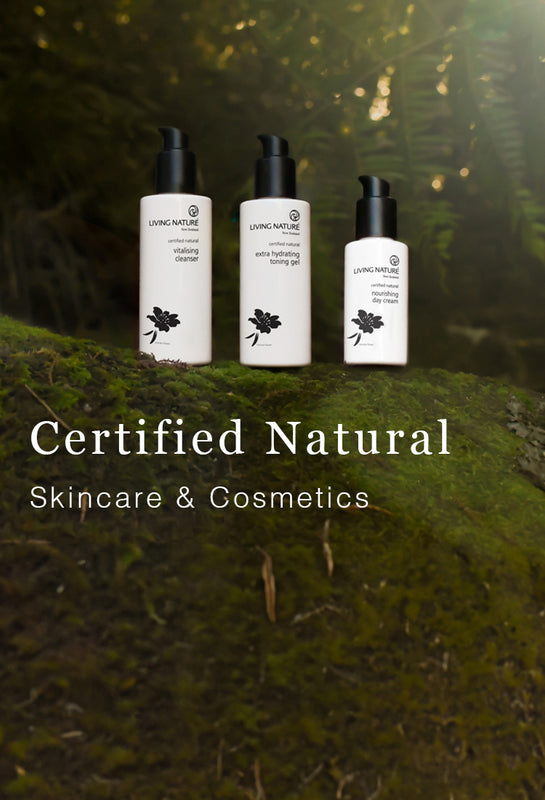
Living Nature is proudly 100% natural, setting some of the world's highest natural skincare standards. We have harnessed the power of New Zealand's unique native botanicals with their incredible purifying, healing and nourishing properties.
100% natural
When it comes to skincare, what you leave out is as important as what you put in. So we take great care to ensure we never include any potentially harmful substances in our skin and personal care products. They are certified 100% free from:
Synthetic preservatives, such as parabens or phenoxyethanol
Harsh surfactants, such as sodium, ammonium and lauryl/ laureth sulphates
Petrochemicals, including PEGs, paraffin and other glycols
Silicones
Mineral oils
Genetically modified or irradiated ingredients
Artificial fragrances
Grain alcohols
Chemical sun protection filters.
Nature's wisdom, world-class science
We have researched and developed our own formulations to harness the powerful purifying,
healing and nourishing properties of New Zealand's native plants. Every Living Nature product undergoes rigorous testing for purity and safety. Our skincare ingredients and products are independently tested for effectiveness.
Independently proven to be safe and effective
Certified Natural by BDIH Germany, a world-leading independent auditor of natural skincare and cosmetics. This means that our products have satisfied BDIH's stringent standards of purity and natural origin.
Our Fragrances
Inspired by New Zealand's unique native flora, our certified natural fragrances have been developed by a master French parfumier especially for our world-leading natural skincare, bodycare and haircare ranges.
The fragrances are crafted from natural essential oils, and are part of our commitment to always provide you with the most natural, safe and effective skincare in the world. Essential oil blends have very different properties to synthetic perfumes. The fragrance of your Living Nature product will always be strongest when you first open and use it, and will naturally soften over time.
Fragrances are listed in ingredients as "Parfum (fragrance)" which is the international labelling standard. We list any known essential oil allergens on packaging, and always recommend that you patch test products before use, particularly if you have sensitive skin.
Once part of the ancient southern landmass, Gondwana, New Zealand has been geographically isolated for over 80 million years, in which time a unique flora has evolved. Over 80% of New Zealand’s plants are found nowhere else in the world. It is these rare plants that form the basis of the exceptional Living Nature skincare, bodycare care and cosmetic collections.
Living Nature also use essential oils, citrus oils, flower extracts (such as calendula) as well as, Evening primrose oil, Carrot oil, Jojoba, Nut oils, Cocoa butter, Aloe Vera, Rosehip, and many more…
Introduction with Dr. Greg Clark, PhD in Bio-Chemistry and Plant Physiology
Harakeke is a striking plant and a well known feature in the New Zealand landscape. It is native to New Zealand and a handful of Pacific Islands.
Harakeke is renowned for the clear polysaccharide gel exudates produced on the surface of leaves at the base of the plant. This gel is often referred to as the New Zealand equivalent to Aloe Vera gel. We use it extensively in our products for its skin soothing and hydrating properties. It is also a natural alternative to petrochemically derived synthetic gels.
The large grass-like leaves of Harakeke, which grow to more than 3m in length, were used extensively by Maori for clothing, thatching and matting. They also used Harakeke as a medicinal plant to treat boils, burns, as an antiseptic for cuts and internally for diarrhoea. In early European days in New Zealand, Harakake was named Flax in recognition of its strong leaf fibre which was used to produce rope and linen similar to that produced from the unrelated northern hemisphere common flax plant, Linum.
Parts used: The gel from the base of the leaf, and the seeds for soap making.
Benefits:
Antiseptic, soothing, healing.
Primary components: D-xylose. D-glucuronic acid.
Found in Living Nature products:
Invigorating Body Bar, Vitalising Exfoliant, Hydrating Gel Mask, Balancing Day Lotion, Hydrating Gel, Firming Flax Cream, Firming Eye Gel, Balancing Night Gel, Nature’s Hydrating Mist, Men’s Soothing Aftershave Gel, Soothing Moisturiser, Eye Gel.
Reaching lengths of up to 35 metres at maturity, this plant grows at an incredible rate of half a metre per day.
Growing in the nutrient-rich South Pacific waters that surround New Zealand, the Bladder Kelp (Macrocystis pyrifera) is the fastest growing plant in the world.
Rich in nutrients absorbed from the sea, kelp extracts have been used for years as natural liquid fertilisers for land plants, and as a health supplement by people to boost dietary levels of iodine, potassium, folic acid, B group vitamins as well as vitamins A and D.
Kelp extracts are used in Living Nature products to provide nourishing food for the skin and hair, and silica particularly, for strong, healthy hair. It also has the added benefit of the mild antiseptic properties of iodine and tannin to cleanse and purify.
Parts used: Whole of plant.
Benefits:
Nutrient-rich nourishment. Antiseptic.
Primary components:
Silica, iodine, Vitamin B group, Vitamin A.
Found in Living Nature products: Balancing Shampoo, Nourishing Body Wash,Purifying Hand Wash.
The Kumerahou plant has the wonderful ability to lather by just rubbing the flowers and leaves together in water.
These lathering properties are derived from natural surfactants known as saponins. The gentle cleansing attributes of saponins work without the addition of alkali usually found in soap.
Other benefits of saponins include their ability to mix with oil and water which makes them ideal as a natural cleanser. The presence of saponins in plant tissue is recognised as an important defence mechanism against microbial attack as saponins exhibit strong antimicrobial activity. Saponins are known to have beneficial properties on the skin and are active against the fungi associated with dandruff.
Named Kumerahou by Maori, the flowering ofKumerahou coincides with the planting time for kumara (sweet potato). The leaves have often been used as a tea to help relieve lung congestion and expel mucus.
Parts used: Flowers and leaves.
Benefits: Gentle cleansing and anti-microbial.
Primary components:
Saponins.
Found in Living Nature products: Purifying Body Bar, Purifying Hand Wash, Balancing Shampoo, Nourishing Shampoo, Head Lice Repellent Shampoo, Refreshing Body Wash, Purifying Cleanser, Eye Make-up Remover, Vitalising Cleanser. Mens Gentle Cleansing Shaving Gel, Soothing Shaving Cream.
The benefits of Manuka honey for our skin are extraordinary – moisturising, nourishing, healing, rejuvenating and protecting.
Our key Living Nature hero ingredient, Manuka honey contains nutrients, vitamins, amino acids and minerals. Honey has been used for centuries to aid skin health and beauty. Manuka honey has special qualities that work not only as a humectant, drawing moisture into the skin, but contain a unique active component derived from the Manuka plant that makes this honey one of the most biologically active and beneficial honeys for the skin.
The power of honey to stimulate wound healing and promote healthy skin is well documented. Used on the skin, honey is reported to stimulate the immune system and provide the nutrients for cell metabolism and rapid tissue repair. It also contains lactic acid, which aids in the clearing of dead skin cells.
The bioactivity of Manuka honey, referred to as the unique Manuka factor (UMF), is associated with the strong antimicrobial activity of this honey against the bacteria E. coli and Staph.aureus major, sources of skin and wound infections.
Parts used:
Honey, created from bees using the nectar of manuka flowers.
Benefits:
Antimicrobial and biologically active qualities.
Found in Living Nature products: Round soaps, Purifying Hand Wash, Purifying Body Bar, all Shampoos & Conditioners, all Body Creams and Body Washes, all Facial skincare products except Radiance Night Oil, all Men’s products.
An incredibly versatile plant, Manuka haslong been valued for its healing properties.
Amongst other qualities, Manuka oil has antibacterial, anti-fungal and anti-inflammatory properties making it an ideal combatant to micro-organisms that cause irritation and skin infections, including the bacteria associated with acne.It has been researched extensively for use in hospitals, where it is being found to be effective against the MRSA (Methicillin-Resistant Staph. Aureus) bacteria, which is resistant to normal antibiotics.
The Manuka tree was used traditionally by Maori for a variety of ailments from rheumatism, burns, scalds, fevers, urinal complaints, colds to skin disorders. They also used it as an essential plant for its timber. In the forest, Manuka helps protect young growth allowing larger trees to become established and is one of the first plants to colonise bare land, instrumental in converting wasteland back to native New Zealand bush.
Parts used:
Essential oil extracted from the leaf and branches.
Benefits:
Balancing of skin bacteria, protective.
Primary components: Leptospermone, flavesone.
Found in Living Nature products: Purifying Hand Wash, Shampoos and Conditioners, Body Wash, Hand and Body Creams, Energy Body Oil, Facial Cleansers, Day and Night Creams, Masks and Peels, Firming Flax Cream, Firming Eye Gel, Nature’s Hydrating Mist, all Mens products.
One of the giants of the New Zealand forest and a member of the ancient Gondwanaland group of plants collectively known as Podocarps.
Podocarps evolved during the age of the dinosaur (the Jurrasic period) some 135-195 million years ago and exhibit features such as small sharp pointed leaves that would have offered some protection from the hungry mouths of these now extinct reptile giants.
The wood of the Totara is extremely resistant to decay due to its antimicrobial and potent anti-oxidant activity and because of this, was used extensively for wharf pilings and fence posts by the early European settlers of New Zealand. This anti-oxidant activity is utilised in Living Nature products to protect against oxidative stress and free radicals which break down skin cells.
The raw material for the production of Totarol™ (the compound from the heartwood of the Totara responsible for the wood’s resistance to bacterial attack and oxidative degradation) is sourced from high quality, recycled Totara. No trees are felled for the harvesting of this ingredient. The supercritical extraction process of Totarol™ means it is free from any form of solvent.
Parts used:
Bark and wood.
Benefits: Antimicrobial and potent anti-oxidant activity.
Primary components: Totarol™.
Found in Living Nature products:
Cleansing Clay Peel, Deep Cleansing Mask, Balancing Day Lotion, Nourishing Day Cream, Nourishing Night Cream, Rich Day Cream, Vitalising Cleanser.
Halloysite clay is renowned as one of the finest, whitest and most pure clays in the world.
Due to it’s fine particle structure, and freedom from mineral contaminants common in other clay deposits, Matauri Bay Halloysite clay has a remarkable ability to absorb toxins and impurities from the surface of the skin. This makes it especially beneficial for acne-prone skin and for clearing pores of excess oil that may lead to the formation of blackheads.This poultice activity provides gentle exfoliation, drawing dead skin cells away from the skin surface to leave the skin fresh and accessible to nutrients.
Sourced from Matauri Bay in the far north of New Zealand, this fine particle clay was formed through subtropical weathering of ancient volcanic domes produced some two to nine million years ago. It is also used for the production of fine bone china and porcelain.
Parts used: The clay is dug from the ground and separated from the silica sand that is present.
Benefits:
Gently absorbs pollutants and exfoliates the skin.
Found in Living Nature products:
Deep Cleansing Mask and Cleansing Clay Peel.
We love using the cheerful sunny calendula for its lovely calming and soothing properties, giving the skin respite from irritations.
Used externally, Calendula’s medicinal value is well known. It is one of the best herbs for treating burns, scalds, cuts, abrasions, and infections due to its antiseptic qualities and ability to improve blood flow to an infected area. The constituents that make it such an effective wound healer and anti-inflammatory are flavinoids, saponins and cartenoids.
Native to the Mediterranean, Calendula is now found throughout the world. Named by the Romans who grew it for its beauty and prolific flowering throughout the calendar year. Europeans have used Calendula for hundreds of years, and often added the petals to soups and stews.
Parts used:
Flowers are macerated in Almond Oil.
Benefits:
Soothes pain, reduces bleeding, promotes rapidhealing and aids in preventing scarring.Excellent for use on the following – external bruises, cuts/scrapes, skin irritations, wounds, and as an antibacterial, anti-fl amatory and antiseptic.
Primary components:
Vitamins A and C. Flavinoids, saponins and cartenoids.
Found in Living Nature products: Vitalising Exfoliant, Hydrating Gel Mask, Firming Flax Cream, Radiance Night Oil, Eye Makeup Remover, Lip Balm, Body Form Oil, Tranquility Body Oil. Mens Soothing Aftershave Gel.